Why is My Child Walking on Their Toes? A Parent’s Guide to Toe Walking

Medically Reviewed By: Dr. Vaibhav Mittal, MS Orthopaedics (Paediatric Orthopaedic Surgeon)
Last Updated: June 2026
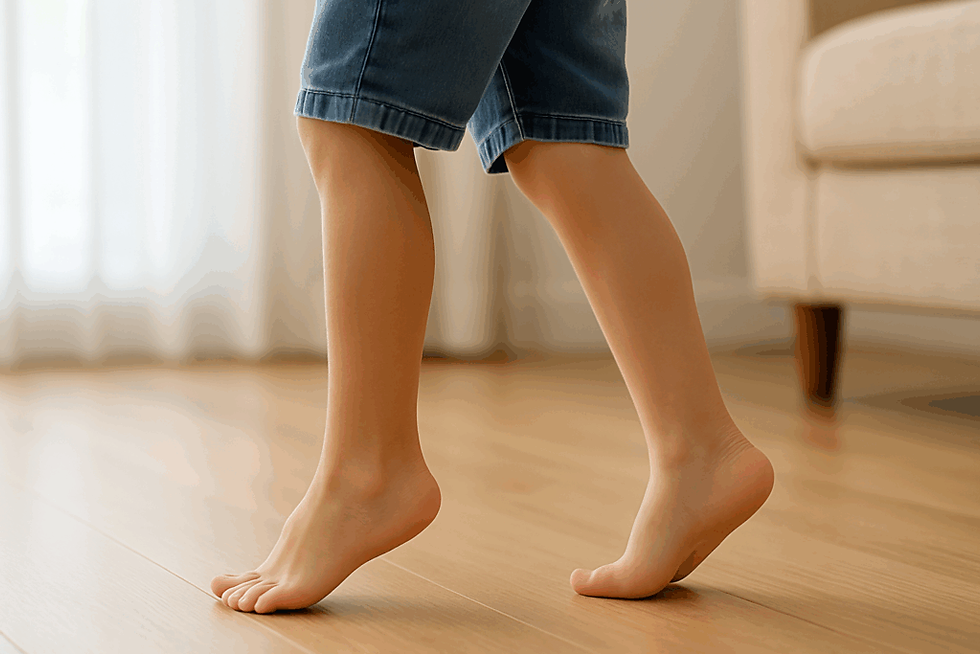
Watching your toddler take their first steps is a major milestone. But as they gain confidence, you might notice something unusual: they are walking entirely on the balls of their feet, with their heels rarely touching the ground.
As a paediatric orthopaedic surgeon, "toe walking" is one of the most common concerns parents bring to my clinic. For most children, it is a harmless, temporary phase of early walking. However, if it persists as they grow older, it is important to have it evaluated to rule out any underlying neuromuscular or developmental conditions.
Here is everything you need to know about toe walking, when to worry, and how we treat it.
What is "Normal" Toe Walking?
When children first learn to walk (around 12 to 18 months), they experiment with different foot positions to find their balance. Walking on their tiptoes is often just a part of this exploration.
If your child is under the age of 2, can stand flat-footed when asked, and is meeting all their other developmental milestones (like crawling, pulling to stand, and talking), toe walking is usually not a cause for alarm.
Idiopathic Toe Walking (ITW)
When a child continues to toe walk past the age of 2 or 3 for no apparent medical reason, we call it Idiopathic Toe Walking (ITW).
Children with ITW are completely healthy and have normal muscle strength. They simply developed a habit of toe walking, which over time can cause the Achilles tendon and calf muscles to become tight, making it physically difficult for them to drop their heels to the floor.
When Should You See a Doctor? (The "Red Flags")
While most cases are simply a habit, persistent toe walking can sometimes be a sign of an underlying medical issue.
You should schedule an evaluation at our clinic if you notice any of the following:
Age: Your child is over 2 or 3 years old and still toe walks constantly.
One-Sided Walking: They walk on the toes of only one foot (unilateral toe walking). This is a major red flag that requires immediate orthopaedic assessment.
Stiffness: Their calf muscles feel extremely tight, or they complain of pain in their legs or ankles.
Frequent Tripping: They struggle to keep up with other children, fall frequently, or have trouble wearing shoes comfortably.
Developmental Delays: They were late to sit or crawl, or they exhibit delayed speech and social skills (which can sometimes be associated with Autism Spectrum Disorder).
Muscle Weakness: They struggle to stand up from a sitting position on the floor, or they seem unusually clumsy (which could point to neuromuscular conditions like Muscular Dystrophy or mild Cerebral Palsy).
How Do We Evaluate Toe Walking?
During your visit to the clinic, my goal is to find the exact cause of the gait pattern. I will conduct a thorough physical and neurological examination, which includes:
Gait Analysis: Watching your child walk and run in the clinic.
Range of Motion (The Silverskiold Test): Checking how tight the Achilles tendon and calf muscles are.
Neurological Checks: Testing muscle reflexes, strength, and tone to rule out spasticity or nerve issues.
In most cases, the diagnosis can be made clinically in the office, but occasionally we may order an X-ray to ensure the bones and spine are developing correctly.
Treatment Options: Getting the Heels Down
Treatment always depends on the age of the child, the tightness of the muscles, and the underlying cause. We always begin with the least invasive approach.
1. Observation and Physical Therapy
For younger children (ages 2 to 5) whose calf muscles are not severely contracted, we often prescribe physical therapy. We teach parents specific, gentle stretching exercises to do at home to lengthen the Achilles tendon and strengthen the front of the legs.
2. Ankle-Foot Orthoses (AFOs)
If stretching isn't enough, we may use custom-molded plastic braces (AFOs) worn during the day or night to hold the foot at a 90-degree angle, providing a constant, gentle stretch.
3. Serial Casting
For stubborn tightness, we apply a series of lightweight, short-leg walking casts. Every week or two, we change the cast, gently stretching the ankle a few degrees further each time until a flat-footed position is achieved.
4. Surgical Intervention
Surgery is rarely our first option, but it is highly effective for older children (usually over age 5) whose Achilles tendons have become permanently shortened. As a paediatric orthopaedic specialist, I perform a minimally invasive tendon lengthening procedure. It is typically a day-care procedure, meaning your child goes home the same day. Following the procedure, they will wear a walking cast for 4 to 6 weeks while the tendon heals in its new, lengthened position.
A Note to Parents
If you notice your child walking on their toes, please do not panic. Avoid constantly telling them to "walk flat," as this can cause frustration. Instead, bring them in for a comprehensive evaluation.
To make this article rank even higher and engage parents more deeply, would you like to plan a short Hinglish video script summarizing these points that you can record for your "Junior Orthopaedic Clinic" YouTube channel and embed directly onto this page?


Comments